


Busy mom marathon training can feel like solving a scheduling puzzle every single week. Long runs compete with work, school mornings, childcare, meals, appointments, and the basic need to recover.
Fortunately, marathon preparation does not have to mean squeezing in as many miles as possible.
Recent research involving Boston Marathon runners suggests that strong performance is associated with consistent training, purposeful quality sessions, cross-training, and smart adjustments as race day approaches.
That message is useful for running moms. Instead of asking how to fit in more workouts, it may be better to ask which sessions matter most.
A sustainable marathon plan should build endurance while leaving enough energy for family life, work, sleep, and recovery.
What Research Says About Busy Mom Marathon Training
A recent Sports Medicine study analyzed the training habits of 917 Boston Marathon runners. The group included 495 women, making the findings especially interesting for female endurance runners.
Researchers looked at weekly mileage, running frequency, harder workouts, cross-training, and changes in training during the months before the marathon.
Faster runners generally completed more total training. They also tended to include more structured quality sessions and cross-training.
However, the findings do not mean every runner should immediately add mileage or harder workouts. The participants were experienced athletes who had qualified for Boston.
For recreational runners and busy moms, the broader lesson is more useful: consistency and purposeful training matter more than random mileage.
Weekly Mileage Matters, but More Is Not Always Better

Marathon runners need enough aerobic training to prepare their bodies for 26.2 miles. Regular running improves endurance, strengthens the musculoskeletal system, and helps the body become more efficient at using energy.
The study found an association between higher running volume and faster marathon performance.
Still, mileage only helps when your body can recover from it.
A mom running 30 consistent miles each week may benefit more than someone repeatedly pushing toward 45 miles and then missing several days because of exhaustion or soreness.
Think of weekly mileage as something to build gradually rather than a score you need to beat.
Use Mileage as a Tool, Not a Competition
Online training posts can make it seem as though every marathoner needs huge weekly mileage. That is not true.
Your ideal volume depends on running history, current fitness, injury history, available time, and how well you recover between sessions.
First-time marathoners may need a more conservative plan. Experienced runners who have spent years developing an aerobic base may tolerate considerably more.
Increase training gradually and watch how your body responds. Persistent soreness, unusual fatigue, poor sleep, declining performance, or loss of motivation may signal that the workload is too high.
If recovery is already difficult, revisit our guide to running recovery for moms in 2026.
Consistency Before Peak Training Makes Marathon Prep Easier
A strong marathon cycle does not begin with the first long run on your official training calendar.
Months of easier, consistent running create the foundation that allows you to handle later mileage and quality workouts.
This matters for moms because life rarely follows a perfect training schedule. A sick child, busy workweek, family event, or poor night of sleep can easily disrupt a workout.
When you have already built a consistent base, missing one session becomes much less important.
A useful goal is to establish a repeatable weekly running routine before the demanding part of marathon preparation begins.
That routine might include three or four runs, one strength session, and enough rest to keep the pattern sustainable.
Quality Workouts Should Have a Specific Purpose
Another important part of busy mom marathon training is making harder workouts count.
Quality sessions may include tempo runs, intervals, hills, fartlek workouts, or marathon-pace segments. Each workout trains the body in a slightly different way.
A tempo run can improve your ability to sustain a controlled hard effort. Shorter intervals can develop speed and running economy. Hill sessions can build strength and reinforce good form.
Marathon-pace workouts help runners practice the rhythm they hope to maintain on race day.
That does not mean your plan needs several difficult workouts every week.
For many recreational marathoners, one focused workout plus the weekly long run creates enough training stress. The remaining runs can stay comfortable.
Cross-Training and Strength Work Can Support Your Running
The Boston Marathon research also found an association between later-period cross-training and faster race performance.
Cross-training can include cycling, swimming, elliptical sessions, brisk walking, or another aerobic activity that places less impact on the legs.
These sessions can add cardiovascular work without requiring another run.
Strength training also supports marathon preparation. Exercises for the glutes, calves, hamstrings, hips, and core can help runners maintain stability when fatigue builds.
Our strength training guide for running moms offers practical ways to add strength without overwhelming your schedule.
Supporting workouts should improve the training plan rather than compete with it. If strength or cross-training consistently leaves you too tired for important runs, reduce the total load.
How to Make a Busy Mom Marathon Training Plan Work
A marathon plan becomes useful only when it fits your actual life.
The best-looking schedule on the internet will not help if it depends on six uninterrupted mornings every week and you realistically have four.
Start with the sessions that matter most. For many runners, that means a long run, one quality workout, and enough easy running to support endurance.
Then build the rest of your week around those priorities.
Plan Your Week Around Key Sessions and Recovery
Place the long run on the day when childcare, work, and family responsibilities make it most realistic.
Next, schedule the harder workout far enough away to give your legs time to recover.
Easy runs can fill the remaining available days. Strength or low-impact cross-training may fit between them if your recovery remains good.
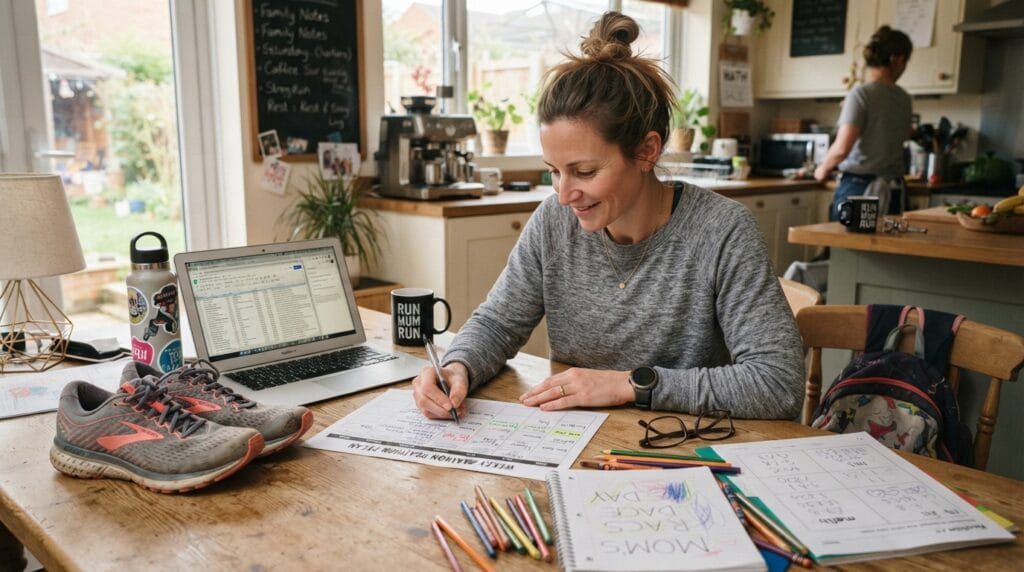
For example, a busy running mom might use Monday for rest, Tuesday for a quality session, Wednesday for strength, Thursday for an easy run, Saturday for the long run, and Sunday for a short recovery session.
That is only an example. Your family schedule may look completely different.
The important part is creating enough space between demanding workouts.
Adjust Training When Work, Family, or Sleep Gets Harder
Your body responds to total stress, not just running stress.
A difficult workweek, several nights of broken sleep, or caring for a sick child can affect recovery just as much as a hard workout.
When life stress rises, adjust the training load instead of forcing the original schedule.
You might shorten an interval session, turn a planned tempo run into an easy run, move the long run by one day, or take a complete rest day.
Those changes do not mean your marathon plan has failed. They can help preserve consistency over the full training cycle.
Wearable technology may help you identify recovery trends, but it should not control every decision. Our guide on using wearable technology smarter in 2026 explains how to combine watch data with how you actually feel.
As race day gets closer, avoid trying to recover missed fitness through last-minute mileage.
The Boston Marathon study found that runners who relatively reduced running frequency during the later training period tended to perform better. That does not establish one perfect taper strategy, but it supports the value of reducing workload before race day.
Your final weeks should help fatigue decrease while preserving the fitness already built.
This is especially important for a marathon plan for busy moms. You do not need to finish every workout perfectly to arrive prepared.
A missed recovery run rarely ruins a marathon cycle. Repeatedly ignoring pain, exhaustion, or poor recovery can create a much bigger problem.
Strong busy mom marathon training combines consistent mileage, purposeful quality workouts, useful cross-training, strength work, and enough recovery to keep the whole plan sustainable.
The goal is not to collect the highest number of miles possible. It is to arrive at the starting line healthy, rested, confident, and prepared for the distance.
For busy runners, flexibility is part of good training rather than a sign that the plan is falling apart.
You can review the research behind these training observations in the Sports Medicine study on marathon training volume, frequency, and race performance.
This article provides general fitness education and is not individualized medical or coaching advice. Training needs vary with experience, health, injury history, pregnancy or postpartum status, and personal goals. Increase mileage and intensity gradually and seek appropriate professional guidance when needed.