

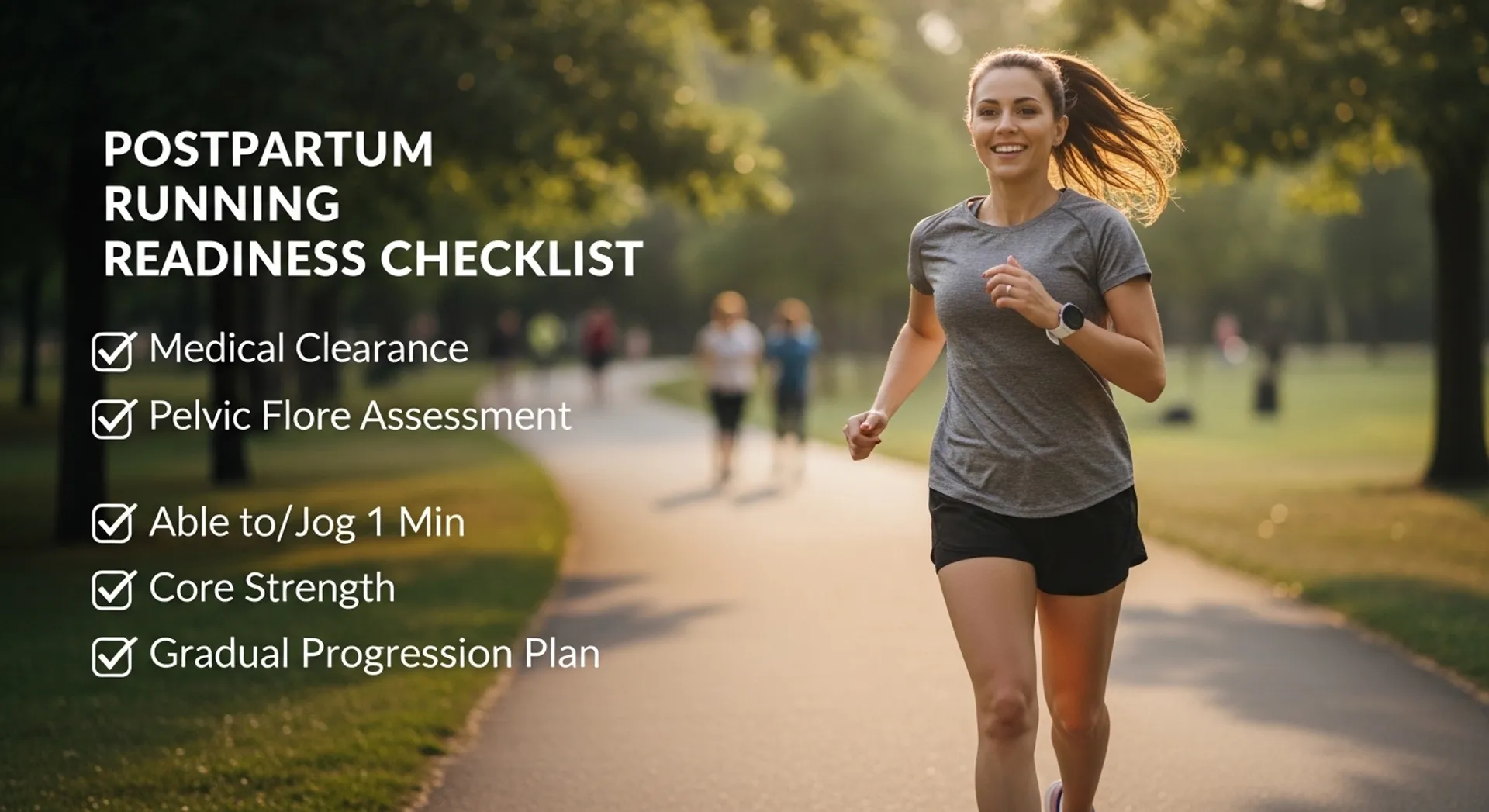
You got cleared at your postpartum checkup… and your brain went straight to, “Okay, when can I run again?” If you’re asking that question, you’re in good company. Running is freedom, stress relief, and a rare moment that belongs to you.
But here’s the truth: a calendar date is not the same as readiness. In 2026, the conversation has shifted toward a more realistic approach—criteria-based return to running that prioritizes pelvic floor function, core control, and symptom screening, not just “6 weeks and go.” That shift is backed by clinical consensus and guidance around postpartum exercise.
This post gives you a practical postpartum running readiness checklist and a simple 12-week run-walk plan you can follow even with a packed mom schedule.
Important: This is general education, not medical advice. If you have pelvic heaviness, leaking, persistent pain, or unusual bleeding, pause and see a qualified clinician (ideally a pelvic health physical therapist).
Why postpartum running “readiness” is trending right now
Two things are happening at the same time:
- More moms want to run sooner (because running is accessible, affordable, and time-efficient).
- More experts are warning against “rush back” logic and pushing symptom-based screening and progressive loading.
ACOG notes that exercise can usually be resumed gradually postpartum when medically safe, but emphasizes that timing depends on delivery type and individual recovery—and that gradual return matters. Meanwhile, expert recommendations in sports medicine have increasingly focused on structured steps and criteria for postpartum return to running rather than guessing.
If you want a quick internal refresher after this post, link this from your blog hub: Run Fast Mommy Blog.
The “readiness” mindset: what you’re actually trying to prove
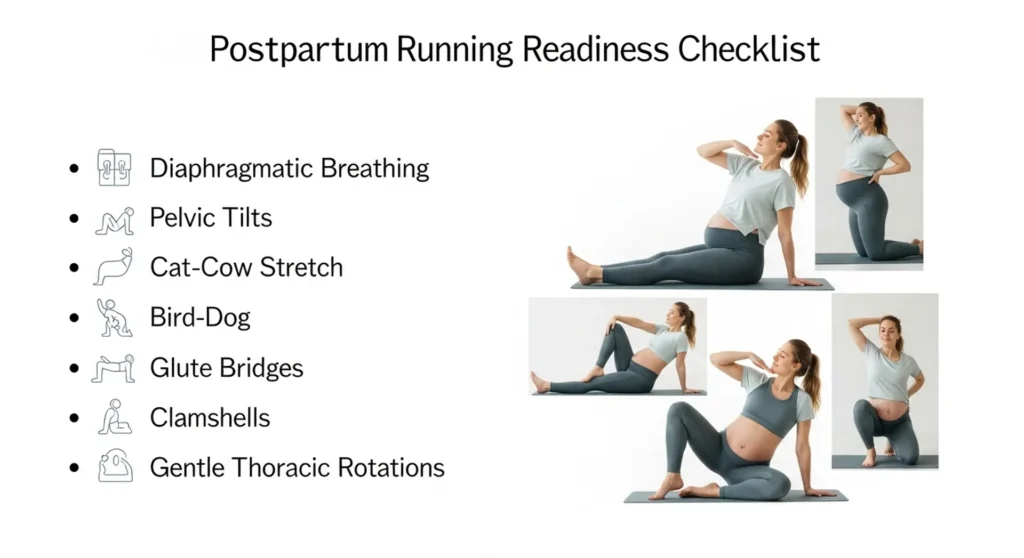
Running is high-impact. Every step is a mini landing. Postpartum, your body is still rebuilding coordination between your diaphragm, deep core, and pelvic floor—especially if you had a C-section, tearing, prolapse symptoms, diastasis recti, or simply a tough recovery.
So your goal is to prove three things before you ramp up:
- You can absorb impact without symptoms (pelvic floor and joints).
- You can control alignment (hips/knees/feet) when you’re tired.
- You can recover from load without your body “pushing back” for days.
Postpartum running readiness checklist (save this)
Use this checklist for your first decision: “Do I start run-walk now, or do I keep building strength first?”
Step 1: Screening questions (your “red flag” filter)
If any of these are happening, do not push running yet—get assessed:
- Leaking urine during exercise
- Pelvic heaviness, dragging, or pressure (especially after activity)
- Pain in the pelvis, low back, hips, or pubic symphysis that worsens with impact
- Doming or bulging along the midline of your belly during basic movements
- Bleeding that increases with activity
ACOG’s postpartum exercise guidance supports gradual return and individualized pacing; if symptoms show up, the plan is to slow down and get help, not “push through.”
Step 2: The “daily life” test
Before you run, you should be able to:
- Walk briskly for 30 minutes without pain or pelvic symptoms
- Climb stairs without knee collapse or hip pain
- Carry your baby/car seat without feeling pelvic heaviness
Step 3: The impact-prep test (simple, no equipment)
Try these on two separate days. If symptoms show up during or after, go back to strength and walking for 2–3 weeks, then retest.
- Single-leg balance: 30 seconds each side
- 10 controlled bodyweight squats (no pain, no “bearing down” pressure)
- 10 single-leg sit-to-stand from a chair each side (slow and controlled)
- 20 calf raises each side (steady, full range)
- 30 seconds of “marching” in place with a firm core (no doming)
The 12-week postpartum run-walk plan (built for busy moms)
This is designed for moms who can realistically run 3 days per week. More isn’t better. Consistency plus recovery is what builds a strong comeback.
Rules:
- Run at conversational pace. No speed work in this phase.
- If symptoms show up (leaking, heaviness, sharp pain), stop and step back a week.
- Strength train 2x/week (short sessions).
Weeks 1–4: Reintroduce impact
- Week 1: 1 min run / 2 min walk x 8 (24 min total)
- Week 2: 1 min run / 1 min walk x 12 (24 min)
- Week 3: 2 min run / 1 min walk x 8 (24 min)
- Week 4: 3 min run / 1 min walk x 6 (24 min)
Weeks 5–8: Build steady running
- Week 5: 5 min run / 1 min walk x 4 (24 min)
- Week 6: 8 min run / 1 min walk x 3 (27 min)
- Week 7: 10 min run / 1 min walk x 2 (22 min) + 5 min easy run
- Week 8: 15 min continuous run + 5 min walk + 10 min easy run
Weeks 9–12: Consolidate (without rushing)
- Week 9: 20 min continuous run (x2) + 25 min run-walk (x1)
- Week 10: 25 min continuous run (x2) + 30 min easy run (x1)
- Week 11: 30 min continuous run (x2) + 35 min easy run (x1)
- Week 12: 35 min continuous run (x2) + 40 min easy run (x1)
Why this works: you’re increasing impact and time gradually, allowing tissues to adapt. Running injury prevention guidance consistently emphasizes progressive load, strength, and smart recovery—not heroic spikes in volume.
The strength minimum (2 sessions/week, 20–30 minutes)
If you do nothing else, do this. Strength is what keeps your hips stable and your knee tracking clean when fatigue hits.
- Glute bridge (2–3 sets of 10–12)
- Split squat or reverse lunge (2–3 sets of 6–10 each side)
- Romanian deadlift hinge (dumbbells or bodyweight) (2–3 sets of 8–12)
- Side plank (2–3 sets of 20–40 seconds)
- Calf raises (2–3 sets of 12–20)
Internal link that fits perfectly here: The 30-Minute Strength Plan for Busy Moms Who Run.
What to do if you feel “off” (but not injured)
Postpartum training has a sneaky enemy: sleep deprivation. If you’re under-sleeping, your nervous system and tissues recover slower. That means “normal” training can feel harder and small aches can linger.
Use this simple decision tool:
- If soreness lasts 24–48 hours: normal, keep going gently.
- If soreness lasts 3+ days or keeps returning: repeat the previous week and prioritize strength.
- If you feel pelvic symptoms: pause running and get assessed.
Smart internal links (keep readers on your site)
- Postpartum Running Tips for Moms: How to Safely Return to Running
- How Moms Can Safely Get Back Into Running After Pregnancy
- Motivation to Run: How Moms Can Stay Inspired Every Step of the Way
- Best Running Gear for Moms: Stay Comfortable and Confident
And for navigation consistency, include your hub link near the end: Run Fast Mommy Blog.
One authoritative external resource (trust + SEO)
For an evidence-based overview on postpartum exercise and gradual return, ACOG is a strong reference point: Physical Activity and Exercise During Pregnancy and the Postpartum Period (ACOG).
Bottom line
The best postpartum comeback is the one that doesn’t create a new problem. Use this postpartum running readiness checklist, build your impact tolerance with run-walk intervals, and anchor the whole thing with short strength sessions.
Running will still be there. The goal is to return feeling strong, stable, and confident—without pelvic floor symptoms, without nagging pain, and without burnout.